
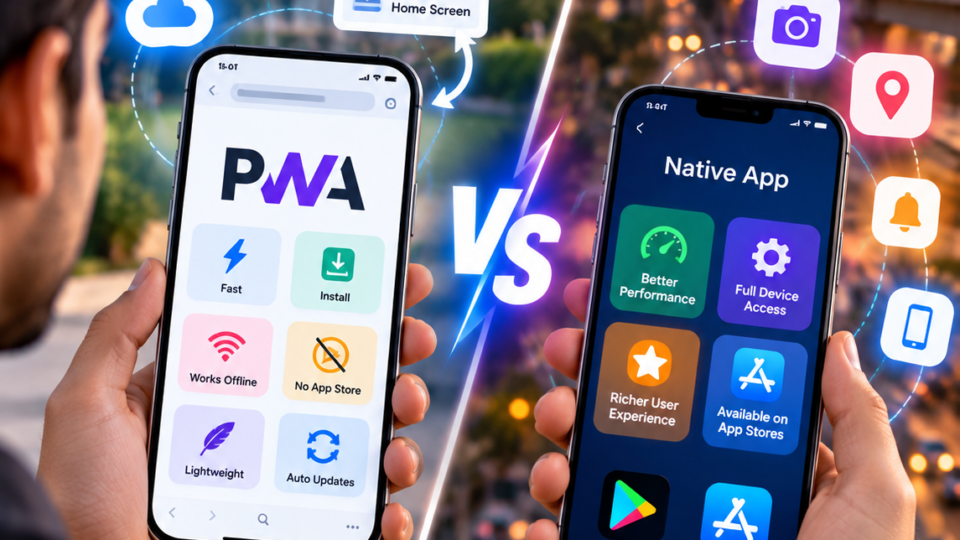
For most growing Indian businesses, the question of whether to build a native app or a Progressive Web App (PWA) is not purely technical — it is a decision shaped by how price-conscious, data-conscious and app-fatigued a huge share of Indian smartphone users have become. Storage space and mobile data are both real, everyday constraints for a large part of the market, and that changes the calculation.
What a PWA actually is
A Progressive Web App is a website built to behave like an app: it can be added to a phone’s home screen, work offline or on a poor connection, send push notifications, and load fast — all without requiring a download from an app store. For a customer who is hesitant to spend limited storage or data on a new app from a brand they are not yet loyal to, this removes the single biggest barrier to trying you out.
Where a PWA genuinely wins
- Zero app-store download friction — a customer can start using it in one tap, straight from a browser or an ad.
- Meaningfully smaller in terms of data and storage, which matters a great deal for budget smartphone users.
- One codebase to maintain instead of separate iOS and Android apps, which usually means faster updates and lower ongoing cost.
- Fully indexable by Google, so it can still drive organic search traffic the way an app store listing alone cannot.
Where a native app still wins
If your product genuinely depends on deep device features — advanced camera use, background location tracking, tight hardware integration — or your business model depends heavily on app store discovery and the trust signal of an app store listing itself, a native app is usually still the better long-term investment.
A practical way to decide
Ask honestly: does a first-time customer need to make a real commitment (a download, an account, storage space) before they can experience any value from you? If yes, a PWA usually converts meaningfully better, because it removes that commitment entirely. If your product’s core value genuinely depends on native hardware features a browser cannot access, that points toward native instead.
Starting lean and growing later
A common, sensible path for a growing business is to launch as a PWA first — validating demand and building a loyal user base with lower cost and effort — and only invest in a native app later, once you have real evidence of demand that justifies the additional development and ongoing app-store maintenance cost.
If you are weighing this decision for your own business, our team can help you decide between a PWA and a native app based on your actual goals and budget, or get in touch to talk it through.